Welcome to WordPress. This is your first post. Edit or delete it, then start writing!
Author: admin
-
First Breeding Record of Egyptian Nightjar in Qatar
The Egyptian Nightjar Caprimulgus aegyptius is one of the two nightjar species that occur in the State of Qatar (the other being Eurasian Nightjar Caprimulgus europaeus), and a favorite among local birders. Being a numerous and long-staying visitor during the summer months, the breeding of this species in Qatar has been suspected for many years. However, due to this species’ secretive behavior, and cryptic plumage, it has proven difficult to obtain sufficient evidence of breeding, and until recently has remained a mystery. Finally, after years of searching for evidence, a historic discovery on May 5, 2024, confirmed suspicions and cemented this species as a confirmed breeder in Qatar.
The breeding was first observed in the desert of northern Qatar by Hamad Al-Khulaify and later followed by Mohammed Al-Thani. Together, these skilled birders found three pairs of Egyptian Nightjars nesting and were able to capture clear photographic evidence of this occurrence. This rare and very exciting finding marks a breakthrough in our knowledge of the Egyptian Nightjar in Qatar and brings us one step closer to understanding this bird’s obscure and mysterious life.

Photo showing Egyptian Nightjar (Caprimulgus aegyptius) with egg and nestling by @Mohammed Al-Thani & @Hamad Al-Khulaify
-
Sociable Lapwings in Qatar
The Sociable Lapwing Vanellus gregarious is a globally threatened wader which breeds in Central Asia and is found in the Middle East on migration and during the winter. The first few records of the species in Qatar were in the early 1980’s but it wasn’t seen again here until 2009. It now occurs in small numbers most years, with peak months October to March. Thus, there were five sightings of up to three birds between mid October 2020 and early March 2021 and up to four between during the winter of 2021-2022. Maximum count of the species was eight birds in 2009.
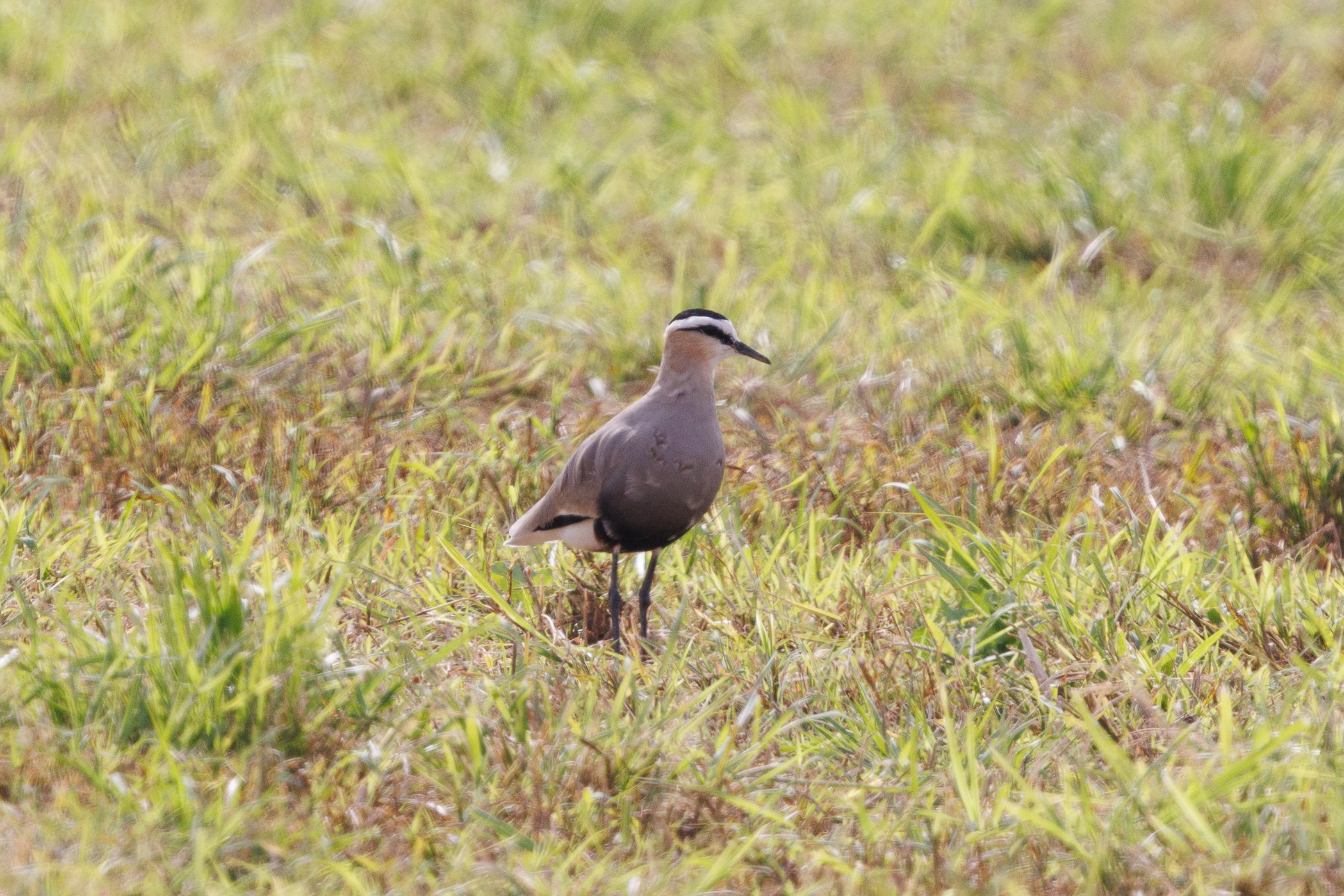
Sociable Lapwing © Simon Tull A recent study of the migration and habitat preferences of breeding and wintering Sociable Lapwing highlights that fact that passage and wintering birds in the Middle East are reliant on farms and other irrigated land (Appleton, 2021; Donald et al 2021). It also appears that over the years they have learned to take more direct migratory pathways to reach these areas; Birds seen in Qatar are assumed to follow a “central” migration route directly southwards from their breeding areas in Kazakhstan rather than a much longer western route through Turkey and Syria, or an eastern route that takes them into India and Pakistan. The wintering site preference for Sociable Lapwing points to two issues (1) The importance of the growth in the number of farms in Qatar, and the generally low intensity way that they are managed and (2) The vulnerability of waste-water lagoons, another habitat used by the species in Qatar – these are affected by widely varying water levels and are often affected by human disturbance.
-
Graceful Prinia – Current status in Qatar
During 2021, the International Ornithological Congress announced a number of taxonomic revisions to the IOC World Bird List. One of these revisions was to Graceful Prinia, a familiar sight in Qatar where it is a resident local breeder. Graceful Prinia (Prinia gracilis) sensu lato has thus been split and a new species, Delicate Prinia (P. lepida) has been established. The split is supported by differences in structure, plumage, song and DNA (Alström et al., 2021). Differences are subtle and to complicate the picture, both species include a number of subspecies.
Delicate Prinia occurs from the easternmost parts of the Arabian peninsula northwards and eastwards into Iran, Iraq and India. Graceful Prinia occurs in Saudi Arabia, Egypt and Oman. The status of Graceful Prinia and Delicate Prinia in Qatar and adjacent parts of Saudi Arabia is currently under investigation since these areas are at the boundary of the distribution of the two species. It currently appears likely that both are present in Qatar but details of their exact distribution remain to be established.
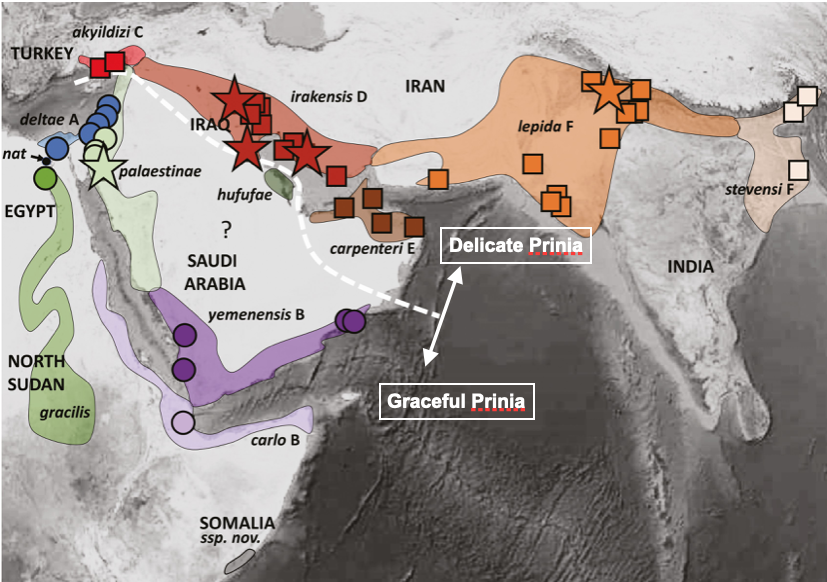
Distribution of Graceful Prinia and Delicate Prinia, after Ahlström, 2021 Key distinguishing field characteristics are:
Graceful Prinia – Structurally larger/bulkier with a relatively short tail. Upper tail barring is very feint, but a subterminal under tail bar is prominent. Plumage tends towards cooler, greyer tones. Song is rather staccato, or slower with gaps between separate bursts. May prefer drier habitats, including parks and gardens including Bidda park, Doha
Delicate Prinia – Structurally more slight, with a longer and thinner tail. Upper tail markings are relatively prominent. Under tail markings are rather feint. Plumage tends towards warmer tones. Song is more continuous, and sounds faster. May prefer wetter habitats such as reed beds, such as can be found at Irkaya Farm.
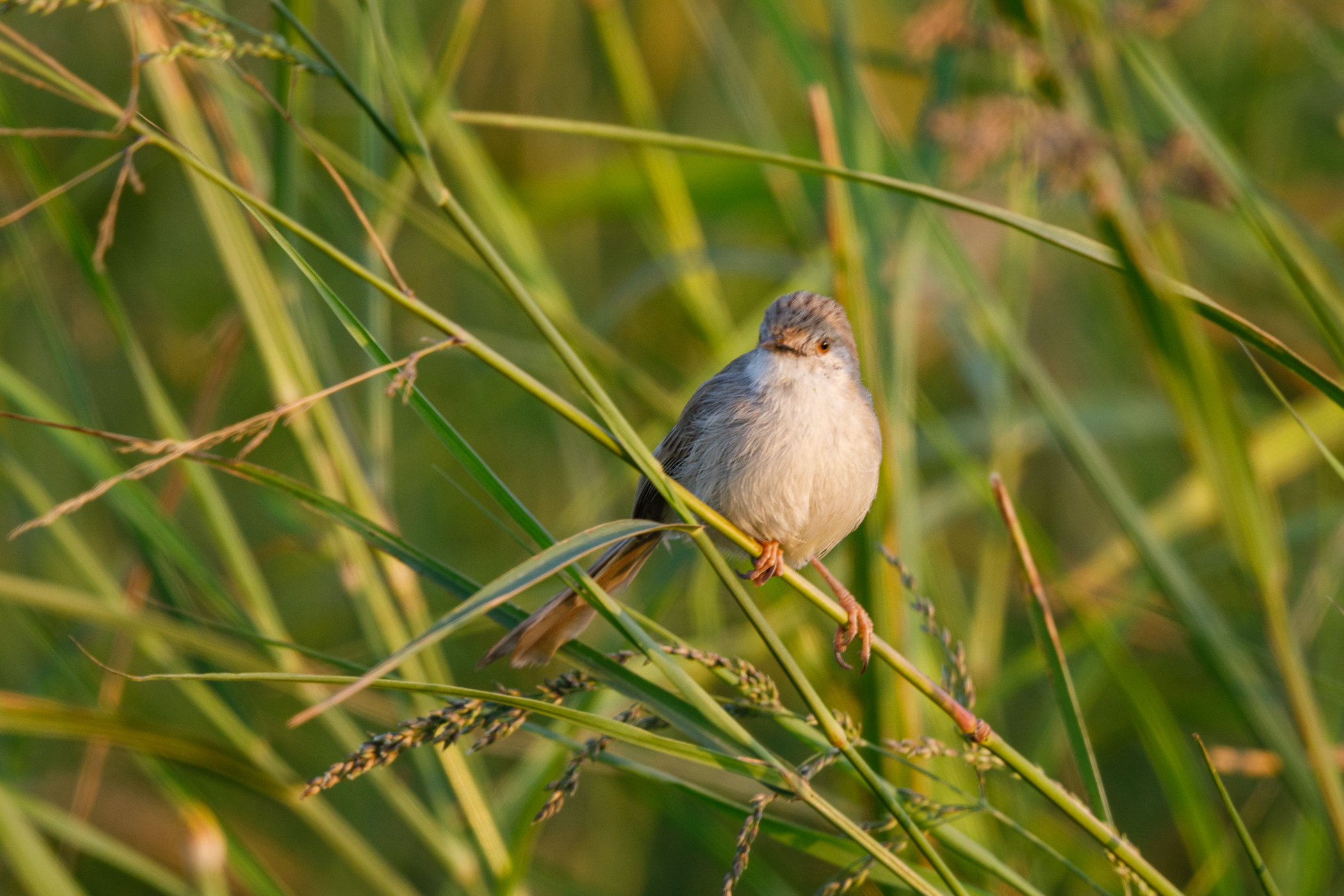
Delicate Prinia © Simon Tull. Note the feint under-tail markings. Irkaya Farm, March 2021 The tail markings and in particular the song are the key defining field characteristics. Clear views of the upper side and under side of the tail are thus important, as are video/audio recordings. Unless either or both are clear, for now at least, it is better to record sightings as Graceful/Delicate Prinia, a convention followed by Ebird.
-
Birdwatching in Qatar
An article about watching migrant birds that appeared in Qatar’s Gulf Times newspaper in recognition of World Migratory Bird Day.
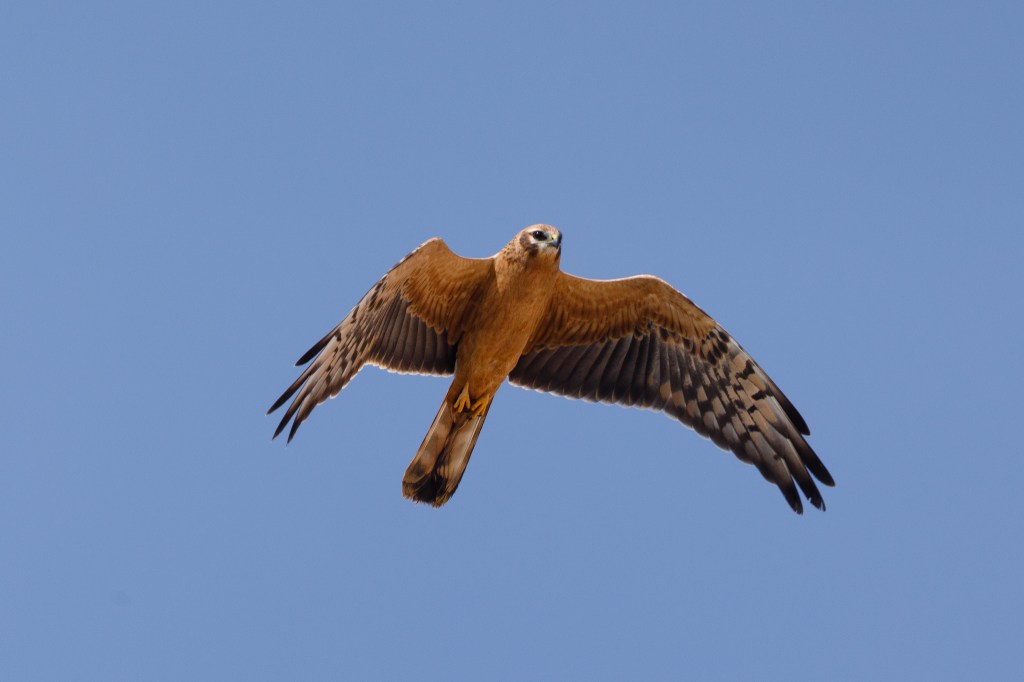
Montague’s Harrier © Simon Tull -
Update to Qatar List
The Qatar Bird List has been updated to 2020. This is the first major update since 2016. The following species have been added, bringing the total number of bird taxa for Qatar to 338. Species added, with their year of their first record, are as follows:
Species Scientific Name Year Lesser Flamingo Phoeniconaias minor 2013 Long-tailed Duck Clangula hyemalis 2016 Indian Pond Heron Ardeola grayii 2016 Moustached Warbler Acrocephalus melanopogon 2016 Allen’s Gallinule Porphyrio alleni 2017 Shikra Accipiter (badius) cenchroides 2017 Pin-Tailed Snipe Gallinago stenura 2017 Brown-necked Raven Corvus ruficollis 2017 Wood Warbler Phylloscopus sibilatrix 2017 Basra Reed Warbler Acrocephalus griseldis 2017 Calandra Lark Melanocorypha calandra 2018 Greater Painted-Snipe Rostratula [benghalensis] benghalensis 2019 Griffon Vulture Gyps fulvus 2020 Ashy / Black Drongo Edolius macrocercus/ E. leucophaeus 2020 Stock Dove Columba oenas oenas 2020 Purple Sunbird Cinnyris asiaticus 2020 Updates to Qatar List, 2020 -
Qatar environment on Al Jazeera News
A feature regarding habitat loss and the threat to wildlife
The challenges Qatar faces balancing nature and development, Al Jazeera News 22 August 2022 -
Qatar birdlife on Al Jazeera News
A feature on Al Jazeera News called “Qatar’s birdlife thriving amid coronavirus restrictions”
Qatar’s birdlife thriving amid pandemic restrictions – Al Jazeera News, 26 May 2020